
Artículo: The Most Relaxing Creative Hobbies for Adults, According to Science
The Most Relaxing Creative Hobbies for Adults, According to Science

People often believe having a hobby is just a way to pass the time. While this is the main reason why most of us take on something in our free time, there are other benefits to it as well. In a world where we’re constantly bombarded with notifications and emails, having something that slows things down and gives your mind some room to breathe is so important.
What makes creative hobbies even more valuable is that they don’t just feel relaxing in the moment. Researchers are constantly looking into how different free-time activities affect stress levels, anxiety, concentration, and overall mental well-being. Their results make it obvious that creative expression helps lower cortisol levels, improves mood, encourages mindfulness, and even supports long-term cognitive health. The best part is that you don’t need to be highly skilled in an activity for it to have this type of effect on you. As long as you engage in something creative, something that requires your full attention, you’ll likely experience many of the same mental and emotional benefits highlighted in the research.
With that in mind, our team looked at what scientific research says about the most relaxing hobbies adults can pick up. By looking at these studies, we came up with a list of five hobbies that have the strongest calming effects and the biggest positive impact on overall well-being.
How Creative Hobbies Affect the Brain

Even if you don’t look at scientific research, it’s easy to understand how relaxing creative hobbies can be. Most of them encourage you to slow down, temporarily disconnect from work and other pressures of daily life, and focus on one task that you’ve set for yourself. This means you get to direct all your attention toward something creative that lets you explore your imagination. This feeling alone is enough to bring some sense of calm and mental clarity.
However, if you want more evidence that these activities are effective, there’s scientific research. Over the years, a lot of studies have been conducted, aiming to prove that creative pursuits affect both mental and physical well-being. The results from these studies have been consistently positive.
One of the biggest reasons why creative hobbies feel relaxing is their effectiveness when it comes to lowering cortisol, the body’s primary stress hormone. A study conducted by researchers at Drexel University found that 75% of participants experienced lower cortisol levels after just 45 minutes of making art, regardless of how skilled they are. Those who participated in the study said that it took them just a few minutes to start obsessing less about their daily life. In fact, they said that focusing on art even helped them put things into perspective.
Both individual experiences and scientific research show that it’s the so-called “flow state” that helps reduce stress. When a person becomes completely absorbed in an activity, they lose track of time and become less aware of outside distractions (work, household chores, and other everyday worries). In other words, the brain shifts its attention from these stressors and focuses only on the task at hand.
With that said, it becomes obvious that taking on a creative hobby can help you manage stress more effectively and give your brain a chance to recover. Now, it all comes down to choosing the perfect hobby for you. Luckily, the possibilities are endless, and finding an activity that matches your personal preferences shouldn’t be too difficult. Still, to help you make a choice, we ranked the most relaxing creative hobbies for adults and used scientific research to prove why they might be the perfect activity for you.
-
Painting

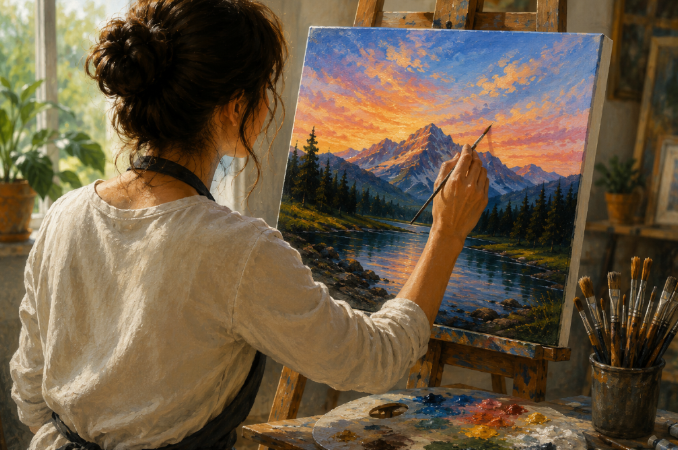
When you think about making art, the first thing that probably comes to your mind is painting. Concentrating on brush strokes, colors, shading, and making simple repetitive movements is exactly the type of activity that helps absorb your brain in the present moment.
One of the reasons painting is so enjoyable is the amount of creative freedom it provides. You can use anything from colors to painting techniques in any way you want. You can experiment and self-express, meaning that you can even explore emotions that would be difficult to communicate through words alone.
Even just looking at art helps your brain relax and recover. A 2011 study showed that simply looking at art can increase blood flow in a certain part of the brain by up to 10%. The participants were shown a series of 30 paintings from famous artists, and the effect on their brains was examined, showing this increase in blood flow. So, art benefits not only the people who create it, but also those who take the time to appreciate it.
Painting isn’t just a great creative hobby for adults, it’s also an easy hobby to take on. When you’re just starting out, you don’t really need expensive supplies, nor do you have to know how to use the most advanced techniques. Instead, a simple set of acrylic paints, a few brushes, and a canvas or sketchbook is enough to begin. Then, you can start with some simple painting projects for beginners and take on more complex projects once you gain more experience.
You can begin by finding a subject in your garden and putting it on canvas. You can also look up online tutorials and find one that looks good for your first painting project. If starting with a blank canvas feels intimidating, you can order a paint-by-numbers kit and follow the numbered guide to create a complete painting step by step. It’s an amazing way to grow your confidence and learn the ins and outs of painting while still ending up with a painting you can proudly hang on a wall.
-
Knitting and Crocheting

The next creative hobby on our list is knitting and crocheting. They may feel like simpler activities than painting, but they both have surprisingly strong effects on stress and anxiety levels. Much of the calming power of knitting and crocheting comes from their repetitive natures. Both activities involve repeating the same hand movements over and over. This creates a rhythm that helps slow the mind and reduce mental noise. People who engage in these activities regularly describe them as meditative, as they don’t require intense concentration and allow the brain to settle into a calmer state.
There's a real comfort in having a clear set of steps to follow. With knitting and crocheting, you're being creative, but the process itself is predictable and familiar, which removes the pressure of constant decision-making. After a long day of solving problems and fielding requests, that kind of low-stakes, structured activity can feel like exactly what your brain needed.
In one US-based survey, 85% of people who engage in knitting and crocheting said that it helps them relax, 81% said it helps them decrease stress, and 57% said it helps them decrease anxiety. In addition, some studies have connected these activities with lower rates of depression and improved cognitive functioning in older adults.
The barrier for starting this hobby is about as low as it gets. A crochet hook or a pair of knitting needles and some yarn is all you need, and none of it will cost you much. Start with something small like a scarf or a dishcloth, follow a beginner tutorial, and go from there. Before long you'll have something real to show for it, whether that's a cozy addition to your home or a gift made with love.
-
Gardening

Gardening is one of the few hobbies on this list where the environment itself does part of the work. Whether you're tending to a full backyard plot or nurturing a few potted herbs on a windowsill, the act of caring for living things demands a kind of quiet, unhurried focus that few other activities can match.
It also keeps you genuinely engaged in a way that passive relaxation doesn't. You're actively doing something, and the results of that effort are right there in front of you. That visible progress, watching something grow because you took care of it, is a big part of why gardening is so effective at putting the mind at ease.
The science backs this up convincingly. Researchers have found that gardening can significantly reduce cortisol levels and improve mood more effectively than many other leisure activities. Additionally, a study by the University of New South Wales tracked adults through their sixties and found that daily gardeners had a 36% lower risk of developing dementia than non-gardeners, suggesting that making it a regular habit could pay off well into the future.
Gardening offers something that's not always easy to come by: a strong sense of purpose. Watching a seed you planted break through the soil, or harvesting vegetables you grew yourself, gives you a quiet but genuine sense of accomplishment. Studies have linked this feeling of nurturing and caring for living things to reduced symptoms of anxiety and depression, and some therapeutic programs now even use gardening specifically as a tool for mental health recovery.
All you need is a backyard. Pick a small patch, grab some basic tools, and start with something easy like tomatoes, sunflowers, or leafy greens. Even if you’re working with limited space, you shouldn’t let that stop you. Herbs like basil, mint, and parsley grow surprisingly well in small pots on a balcony or even a sunny windowsill.
-
Pottery

Not many hobbies demand your full attention the way pottery does. The moment you sit down and put your hands on the clay, your brain has one job, and everything else, the deadlines, the errands, the mental noise of daily life, gets pushed to the side. It's hard to explain until you experience it, but most people who try it become regulars pretty quickly.
A lot of that has to do with touch. Pottery is one of the few creative hobbies that is almost entirely driven by physical sensation. The weight of the clay, the pressure of your hands, the way the shape changes with every small adjustment you make. That constant sensory feedback gives your brain no room to wander — it's one of the most grounding experiences on this entire list. You simply can't be worrying about tomorrow's meeting while trying to keep a clay wall from collapsing.
A 10-week mindfulness-based clay therapy program has been shown to produce significant reductions in both anxiety symptoms and salivary cortisol levels, according to a peer-reviewed pilot study by Beerse, Van Lith, and Stanwood (2019), published in SAGE Open. Even participants assigned to an unstructured, undirected clay-handling task showed a measurable cortisol drop after their first session.
Some researchers attribute this to the fact that pottery engages both sides of the brain simultaneously, blending the technical side of shaping and centering clay with the open-ended creativity of deciding what to make. That combination creates a level of full mental engagement that leaves very little room for stress to creep back in.
There's also something uniquely satisfying about ending up with an object you can actually use. A bowl, a mug, a small dish for your keys. That sense of having made something real and functional makes the whole experience feel more complete.
Getting started is easier than most people expect. Many cities have local pottery studios that offer beginner classes or open studio sessions where you can drop in and work with an instructor nearby. If you'd rather start at home, air-dry clay requires no kiln and no wheel, and it's widely available in craft stores for very little money.
-
Photography

In 2024, we took 1.9 trillion photos worldwide and that number jumped to 2.1 trillion in 2025 (approximately 61,400 photos per second) . It's safe to say that most of them were forgotten within minutes, but for the people who approach photography as a genuine creative hobby rather than just a way to document moments, the experience is something else entirely.
What makes photography particularly effective for stress relief is how completely it narrows your focus. When you're hunting for the right shot, there's genuinely no mental space left for anything else. The only things you’re thinking about at that moment are finding the right angle and capturing the photo at the right time. Researchers have found that nature photography can significantly lower stress levels and improve mood, with the combination of being outdoors and having a creative focus producing stronger results than simply going for a walk. In fact, just five minutes of nature photography is enough to reduce stress levels among young adults.
There's also a quieter side to photography that tends to go unnoticed. The time you spend afterward, going back through your shots, editing, deciding which ones are worth keeping, has its own calm to it. It's a slower, more reflective process that gives you a second experience of whatever you were photographing, and for a lot of people that turns out to be just as enjoyable as the shooting itself.
As far as getting started goes, photography has one advantage that none of the other hobbies on this list can match. You probably already have everything you need. A smartphone camera is more than enough to start developing an eye for composition and to feel the benefits of getting outside with a purpose. If you eventually want to invest in a dedicated camera, an entry-level mirrorless model will serve you well for years. But that's a decision for later. For now, the best thing you can do is head outside and start capturing photos with your phone.
Conclusion
The research is consistent enough at this point that it's hard to ignore: creative hobbies aren't a luxury or a nice-to-have. For most adults navigating chronic low-grade stress, they're closer to a necessity.
What's striking about the science isn't just that these activities reduce cortisol or improve mood — it's that the benefits show up almost immediately, regardless of skill level. You don't need to be good at painting or pottery for your brain to respond. You just need to be doing it. That's a genuinely rare quality in anything that's good for you.
The mistake most people make is treating a creative hobby as something to pick up once life calms down. It rarely does. The hobby is the thing that helps you handle everything else — not the reward you get once you've handled it.
If you've been on the fence, any of the five on this list is a worthy starting point. But if we had to pick one for someone who has never tried any of them, we'd say painting. The barrier to entry is low, the creative freedom is immediate, and if a blank canvas still feels like too much, a paint-by-number kit gives you a structured way in without sacrificing any of the mental benefits. It's the rare starting point that's both easy and genuinely worthwhile.
Frequently Asked Questions (FAQ):
1. Do I need any prior experience to benefit from creative hobbies?
No. Research shows that the mental and physical benefits of creative hobbies kick in early, regardless of your skill level. What matters most is simply engaging in the activity.
2. Can creative hobbies improve long-term mental health?
Yes. Regular engagement in creative hobbies has been linked to lower rates of depression, reduced anxiety, and even a lower risk of dementia in older adults.
3. How often should I practice a creative hobby to see mental health benefits?
Even occasional engagement can be beneficial, but making it a regular habit maximizes the results. Studies suggest that consistent participation leads to more sustained improvements in mood, stress levels, and overall cognitive health.
4. How do creative hobbies differ from passive relaxation like watching TV?
Passive activities like watching TV allow the mind to wander and can sometimes increase anxiety. Creative hobbies actively engage the brain, encouraging a flow state that more effectively reduces stress and leaves you feeling genuinely recharged.
5. How do I find the right creative hobby for me?
The best creative hobby is simply one that captures your attention and feels enjoyable. Consider what type of activity appeals to you, whether that's something physical, visual, or structured, and start there. The benefits come from consistent engagement, so choosing something you genuinely enjoy matters most.