
Watercolor Painting Ideas for Beginners: 15 Simple Projects to Start

There's a moment every beginner painter knows well: you buy the supplies, sit down at the table, and suddenly have no idea where to start. Watercolor painting ideas are everywhere online, but most tutorials assume you already know what you're doing. This guide is designed to help you with that.
Watercolor is a medium that rewards curiosity more than precision. The paint moves on its own, bleeds into unexpected shapes, and occasionally produces something more beautiful than anything you planned. That unpredictability is the point, not a bug to fix.
We at Number Artist believe that picking the right first project matters more than most people think. The wrong starting point leads to frustration; the right one builds confidence fast. The 15 ideas ahead are chosen specifically for beginners, covering a range of techniques without overwhelming you from the start.
What You Need to Get Started
Before you pick up a brush, you need a small set of reliable tools. You don't need to spend a fortune, and you don't need a professional studio setup. A modest beginner kit covers the vast majority of what these projects require, and once you have it assembled, you can jump straight into work without any detours.
-
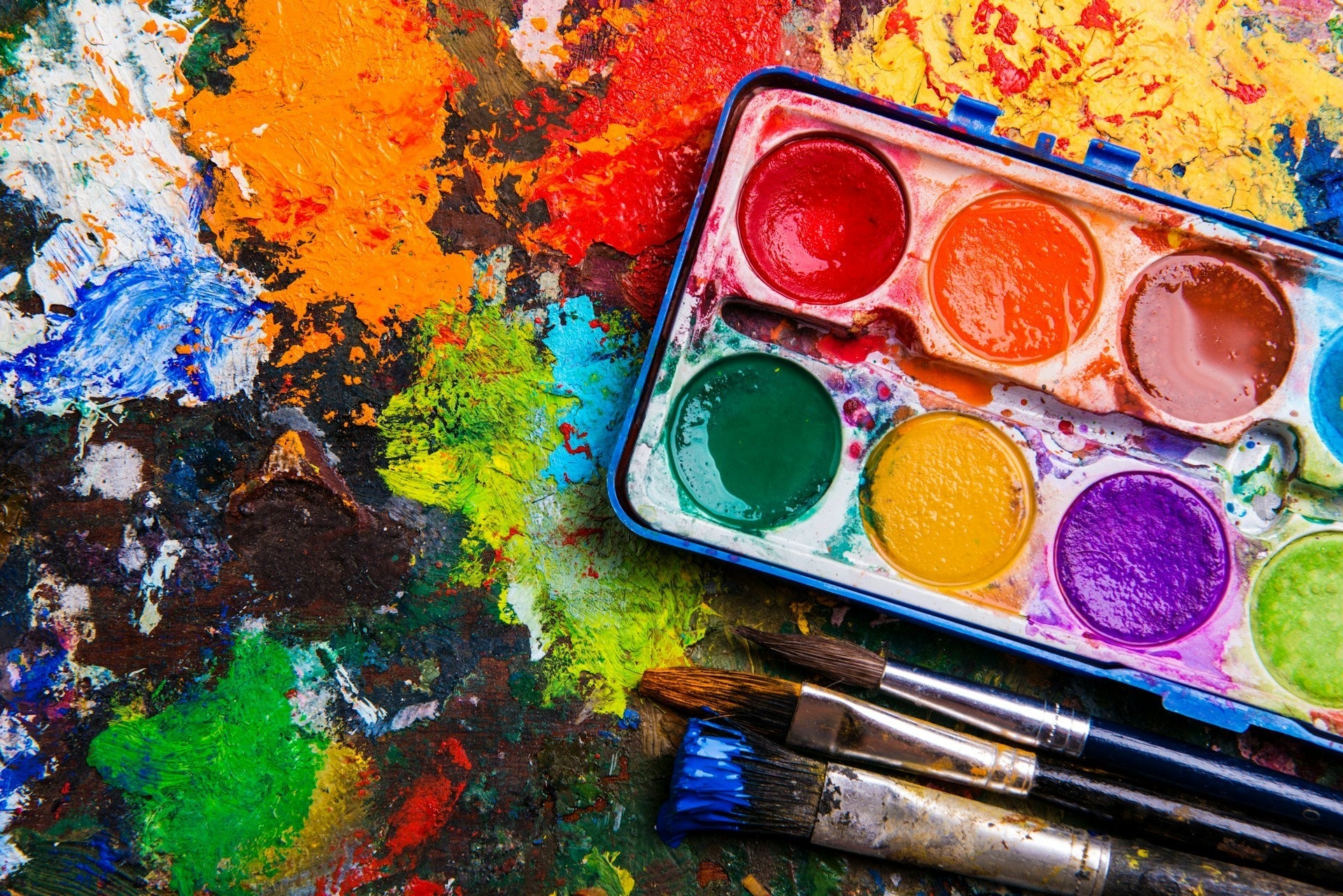
Watercolor paints: a basic 12- or 24-pan set works well for beginners
-
Watercolor paper: 140lb cold-press paper holds water without warping
-
Brushes: a round size 4, a round size 8, and a flat wash brush cover most needs
-
A palette: for mixing colors, even a ceramic plate works fine
-
Two water jars: one for rinsing, one for clean water
-
Masking tape: to secure paper to a board and create clean edges
-
A pencil and eraser: for light sketching before you paint
15 Easy Watercolor Painting Ideas
With these seven items in hand, you're ready to take on every project on this list.
1. A Simple Sunset Sky

Few things teach you watercolor faster than a sunset. The whole exercise is really just two or three colors bleeding into each other across wet paper, and that simplicity is exactly what makes it so effective for beginners. You don't need drawing skills, architectural precision, or any prior experience with watercolor art to pull this off.
What you need: Round size 8 brush, yellow, orange, and pink pan colors, watercolor paper, and clean water.
How it builds your skills: This project introduces the wet-on-wet technique, where you apply paint to already-wet paper and let the colors merge naturally. It trains your eye for color gradients and teaches you how much water to load onto your brush, which is one of the most fundamental skills in watercolor painting.
2. A Single Flower
A single flower (like a poppy or a daisy) strips away complexity and lets you focus on one shape at a time. Beginners often overwhelm themselves by trying to paint full scenes immediately. Starting with one subject at the center of the page teaches compositional instincts without the pressure to fill every corner.
What you need: A round size 4 brush, two or three colors of your choice, and a pencil for a light sketch outline.
How it builds your skills: Painting a flower introduces petal-by-petal brushwork and teaches you to intentionally leave white space. You also start to develop a feel for paint consistency, learning the difference between a watery wash and a more pigment-heavy stroke within the same small painting.
3. A Basic Landscape with Rolling Hills
Rolling hills ask very little of you technically, but they deliver a lot in terms of what you learn. The composition is three or four horizontal bands of color, each slightly darker as you move toward the foreground. That layering principle sits at the heart of watercolor paintings, and this project makes it immediately tangible.
What you need: Flat wash brush, round size 8, greens and blues, masking tape to keep edges clean.
How it builds your skills: Working in horizontal layers teaches you to wait for each wash to dry before applying the next, which is one of the habits that separates muddy results from clean ones. You also start to understand how color value, lighter in the distance and darker up close, creates a sense of depth.
4. A Glass of Water or Simple Still Life
A glass of water sounds almost too ordinary to paint, but that ordinariness is precisely what makes it such a clever beginner project. Transparent objects force you to observe how light behaves rather than relying on memory or assumption. Most beginners paint what they think something looks like. This project trains you to paint what you actually see.
What you need: A round size 4 brush, a limited palette of blues and grays, pencil for a light outline sketch.
How it builds your skills: Painting glass introduces negative space thinking, where the shape of the object is defined as much by what you leave unpainted as by what you fill in. It also develops your control over very diluted washes, since glass requires subtle, transparent layers rather than bold strokes.
5. A Slice of Fruit

Fruit cross-sections – a halved orange, a split watermelon, and a single lemon slice – are among the most forgiving subjects in easy watercolor drawing. The shapes are rounded and symmetrical, the colors are vivid and forgiving of slight inconsistencies, and the subject itself is small enough to finish in a single sitting without losing momentum.
What you need: Round-tip brushes in sizes 4 and 8, bright, pigment-heavy colors, and clean water for softening edges.
How it builds your skills: A fruit slice teaches you to work from light to dark, since watercolor is a subtractive medium where you can always add more pigment but can rarely take it back. You also practice painting a defined outline while keeping the interior washes loose and organic, a balance you return to constantly in watercolor art.
6. Loose Watercolor Leaves
Leaves, as subjects, actively reward a lack of control in the painter’s hand. Unlike architectural subjects or portraits, a leaf that comes out slightly lopsided or unevenly colored still looks like a leaf. That forgiveness makes this one of the most genuinely relaxing early projects, and the benefits of creative activities for adults go well beyond just learning a new skill.
What you need: A round size 8 brush, a range of greens, yellows, and ochres, and watercolor paper with enough texture to hold layered washes.
How it builds your skills: Loose-leaf painting introduces the concept of working wet-on-dry, where you apply wet paint to dry paper for sharper, more defined edges. Alternating between wet-on-wet and wet-on-dry within the same leaf teaches you to control the softness or crispness of any edge you paint, which carries over into every project that follows.
7. A Simple Mountain Range
Mountains are subjects that look complex when viewed from a distance. But when you look them up close, you’ll notice how they break down into surprisingly simple shapes. Each peak is essentially a triangle, and the entire composition is just a series of overlapping triangles arranged across the page. That geometric simplicity makes this one of the most accessible projects for anyone still building confidence.
What you need: Flat wash brush, round size 8, a palette of blues, purples, and grays, masking tape for clean borders.
How it builds your skills: A mountain range teaches atmospheric perspective, the principle that objects farther away appear lighter and cooler in color. Working from background to foreground, you practice layering washes while maintaining tonal contrast between each row of peaks, a technique that sharpens your understanding of depth across the entire page.
8. A Rainy Street Puddle Reflection
A puddle reflection is a very forgiving version of the concept. The distortion of water means imprecision reads as realism rather than error. A slightly wobbly reflection in a puddle looks exactly like a slightly wobbly reflection in a puddle, so the medium works in your favor here more than almost anywhere else.
What you need: Round size 8 brush, flat wash brush, a limited urban palette of grays, blues, and muted yellows, clean water for blending.
How it builds your skills: This project develops your ability to work quickly on wet paper before it dries, since puddle reflections require soft, diffused edges that only come from painting into a still-wet wash. It also introduces the idea of a limited color palette, teaching you to create mood and atmosphere through restraint rather than variety. It also works well for someone just learning to draw water ripples.
9. A Single Tree in a Field
A lone tree against an open sky is one of those compositions that has existed in watercolor painting for centuries, and it has endured for good reason. The subject is immediately readable, emotionally resonant, and technically manageable for someone still developing their watercolor painting for beginners toolkit.
What you need: Round size 4 for branch detail, round size 8 for the canopy and sky wash, greens, browns, and a blue for the background.
How it builds your skills: Painting a tree introduces organic brushwork, where you stop trying to control every stroke and instead let the bristles splay naturally to suggest foliage texture. The trunk and branches also give you practice with fine line work using a nearly dry brush, which builds the kind of brush control that pays off across dozens of future projects.
10. A Simple Lighthouse
A lighthouse often feels iconic without being technically demanding. The structure is a vertical cylinder with a few horizontal bands of color and a light housing on top, and that geometric clarity gives beginners a reliable framework to work within. Having a defined structure to follow frees up your attention for the watercolor technique itself rather than the drawing challenge.
What you need: Round size 4 for detail work, flat wash brush for the sky and sea background, reds, whites, and blues, masking tape for straight edges.
How it builds your skills: A lighthouse composition naturally divides into three distinct zones, the sky, the sea, and the structure itself, and painting each one separately teaches you to approach a composition in planned stages rather than attacking the whole page at once. Also, the tower's straight vertical lines give you practice in controlled, deliberate brushstrokes alongside the looser washes of the background.
11. A Starry Night Sky
A night sky is one of the most technically straightforward watercolor painting ideas for beginners to execute, even though it feels ambitious on paper. The background is a single dark wash, the stars are dots of reserved white or white gouache, and the whole composition comes together faster than almost any other project on this list.
What you need: Round size 8 for the background wash, a fine round size 2 for star details, deep blues, purples, and blacks, and white gouache for star highlights.
How it builds your skills: Painting a night sky teaches you to mix a deep, even wash without streaking, which requires confident, uninterrupted brush strokes across a large area of wet paper. It also introduces white gouache as a tool, showing you how opaque paint behaves differently from transparent watercolor and when each approach serves the painting better.
12. A Simple Seascape with Waves
Water is the subject most beginners assume they cannot paint, and a simple seascape is the project that tends to change that assumption fastest. Waves are not precise objects. They shift, overlap, and dissolve into foam, and that inherent looseness means your brushwork never needs to be exact to read as convincing.
What you need: Flat wash brush for the horizon and large wave shapes, round size 8 for mid-ground detail, blues, greens, and a touch of white gouache for foam.
How it builds your skills: A seascape develops your sense of rhythm in brushwork. Waves repeat with variation, being similar in structure and different in size and energy. Painting a few of them in sequence trains your hand to produce consistent shapes while keeping them loose enough to feel natural. However, the more valuable lesson is learning to leave unpainted gaps that read as white foam and reflected light, trusting the paper itself to carry part of the composition.
13. A Simple Bird on a Branch
A bird on a branch looks delicate and considered without demanding much technical precision from the painter. The bird itself is essentially two oval shapes, a body and a head, with a few strokes for the tail and wings. That reduction of a living creature down to its simplest readable form is one of the most useful perceptual skills watercolor painting can teach you early on.
What you need: Round size 4 for the bird body and branch detail, round size 2 for the eye and fine feather suggestions, earth tones and grays, a touch of a brighter color for accent.
How it builds your skills: Painting a small bird teaches the economy of brushwork. Every stroke needs to contribute something, since overworking a small subject muddies it quickly. You also practice painting a subject that sits within a larger negative space, which sharpens your instinct for scale, placement, and the relationship between a focal point and the empty page around it.
14. An Abstract Color Wash
Every project on this list has asked you to paint something recognizable, and this one asks you to let that go entirely. An abstract color wash is exactly what it sounds like: wet paper, two or three colors, and no agenda beyond watching what happens when pigment moves freely across a saturated surface. Sometimes the most instructive thing you can do is remove the subject altogether and just study the paint.
What you need: Flat wash brush, round size 8, any three colors that appeal to you, a generously wet sheet of watercolor paper.
How it builds your skills: An abstract color wash teaches you to observe in which ways pigment can interact without the pressure of producing a recognizable result. You learn which colors blend smoothly, which ones push each other aside, and which ones granulate into unexpected textures. This project also builds your comfort with letting the medium lead, knowing when to add another drop of color and when to step back entirely.
15. A Simple Cottage or House
A cottage brings together almost every skill the previous fourteen projects have introduced, and that makes it the natural closing project for this list. You have a geometric structure like the lighthouse, a natural setting like the tree or the hills, loose organic elements like foliage and grass, and a sky wash tying everything together. It is, in a quiet way, a summary of everything you have practiced.
What you need: Round size 4 for windows, doors, and fine structural detail, a flat wash brush for the sky and foreground, and a full palette drawing on warm and cool tones across the composition.
How it builds your skills: Painting a cottage asks you to manage multiple elements within a single composition without letting any one of them overwhelm the others. That balance, knowing when a background wash is done, when a detail is enough, when to stop, is the judgment that separates a confident painter from a hesitant one. Simple watercolor painting projects rarely ask for this kind of editorial restraint, and developing it here sets you up well for more complex work ahead.
Wrap Up
Ideas for your newest painting are everywhere, be patient and you’ll catch them. Also, knowing where to start makes all the difference between a hobby that sticks and a set of paints that collects dust on a shelf. The fifteen projects above move from the simplest possible exercises to compositions that pull together everything you have learned along the way. Each project builds on the last, quietly stacking skills before you even notice them accumulating.
Also, the medium itself is worth trusting. Watercolor has a reputation for being difficult, but that reputation mostly comes from fighting the paint rather than working with it. Once you stop expecting precision and start expecting surprise, the whole experience shifts. The unpredictability that frustrated you in the first session becomes the thing you look forward to most by the tenth.
Frequently Asked Questions (FAQ):
1. What are the easiest watercolor painting ideas for absolute beginners?
Sunset skies, single flowers, and loose-leaf paintings are the most forgiving starting points. They require minimal drawing skill, use simple shapes, and tolerate imprecision well. Starting with subjects that have no single correct version removes pressure and lets you focus on getting comfortable with the paint itself.
2. Do I need expensive supplies to start watercolor painting as a beginner?
No. A basic 12-pan student-grade set, a sheet of 140lb cold-press watercolor paper, and three brushes cover everything you need for the projects on this list. Quality paper matters more than quality paint at the beginner stage, so if you are going to spend a little more anywhere, spend it there.
3. How do I stop my watercolor paintings from looking muddy?
Muddy results almost always come from one of two habits: overworking wet paint with the brush, or mixing too many colors together in the same wash. Letting each layer dry fully before adding the next and limiting your palette to two or three colors per painting solves most muddiness problems without requiring any advanced technique.
4. Can I learn watercolor painting on my own without classes?
Yes, and the fifteen projects above are structured precisely for that purpose. Starting with simple, single-subject compositions and gradually introducing more complex arrangements mirrors the progression of a structured course. Repeating each project two or three times before moving on accelerates the learning curve considerably more than rushing through new subjects does.
5. How long does it take to get good at easy watercolor paintings?
Consistent practice matters far more than the number of hours you log in any single session. Fifteen to twenty minutes a day, four or five times a week, produces noticeable improvement within six to eight weeks for most beginners. The key is regularity rather than marathon sessions, since shorter, focused practice keeps frustration low and momentum high.